
Your Agent Changed Under the Model Name - 2026-07-13
OpenAI's serving reversals show why agent systems need versioned harness metadata, while the traces, corrections, evals, and memory around them are becoming proprietary infrastructure.


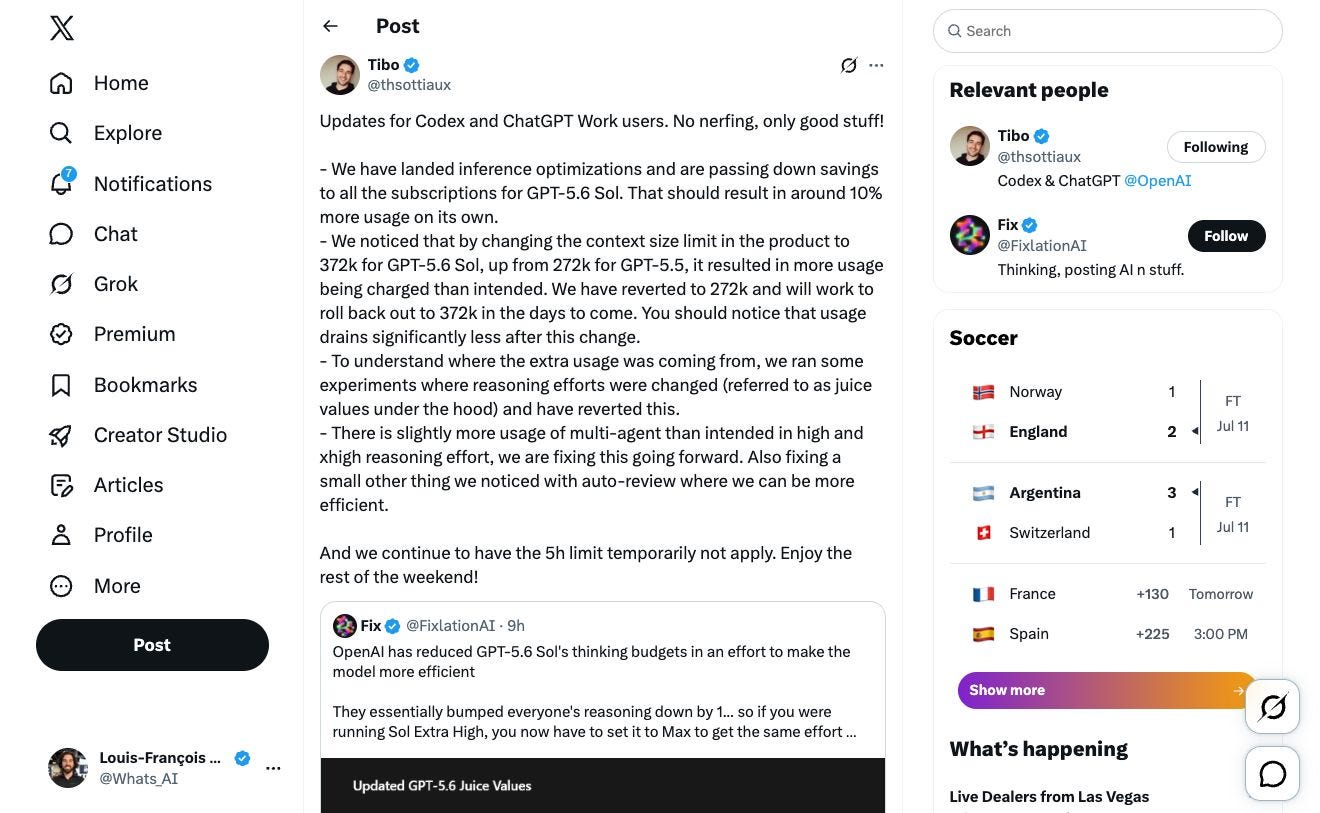
OpenAI’s serving reversals and a Codex prompt rollback show why agent systems need versioned harness metadata, while Satya Nadella argues that the traces...
Scan window: 2026-07-12 06:01 to 2026-07-13 06:01 America/Toronto
Most crucial updates
1. Your agent changed under the model name
Importance: 10/10
OpenAI reverted a context-size increase after it charged more usage than intended, rolled back reasoning-effort experiments, adjusted unexpectedly high multi-agent use, and fixed auto-review inefficiency. Codex 0.144.2 separately restored its prior Guardian review prompt and tool behavior after a regression.
Why it matters: A model name is not a complete production version. Record the harness, prompt bundle, context policy, reasoning effort, routing, tool policy, and review policy with every eval and production trace.
What to watch: If the model stayed the same but the prompt, context limit, and agent topology changed, did you deploy a new agent anyway?
Caveat: The serving details came from a first-party engineer’s X post rather than a formal incident report. The Codex rollback confirms one concrete prompting regression, not every reported behavior change.
Sources: X/Twitter @thsottiaux: Tibo Sottiaux: OpenAI serving changes and reversals, GitHub openai/codex: OpenAI Codex 0.144.2: Guardian prompt rollback


2. Your corrections and evals are becoming enterprise IP
Importance: 9/10
Satya Nadella calls the prompts, corrections, traces, evals, decisions, and adapted context created while using AI ‘intelligence exhaust’ and argues organizations should own this learning loop.
Why it matters: The durable asset may be the correction-and-evaluation loop that teaches an agent how an organization works. Model portability is hollow if that loop is trapped inside one vendor’s orchestration layer.
What to watch: Enterprise AI lock-in will not come only from models. It will come from losing ownership of the feedback loop that made the agent useful.
Caveat: This is a strategic argument from Microsoft’s CEO, not a neutral standard or product guarantee. Microsoft has clear platform incentives around tenant-bound data and orchestration.
Sources: X/Twitter @satyanadella: Satya Nadella: The Reverse Information Paradox

3. Agent quotas are now part of production behavior
Importance: 8/10
Anthropic extended Fable 5 access on paid plans and kept Claude Code weekly limits 50% higher through July 19, changing immediate agent capacity without explaining what comes after the extension.
Why it matters: Quotas and temporary multipliers can decide whether an agent workflow finishes. Production systems need local budgets, fallbacks, routing, and graceful degradation.
What to watch: A quota banner is now a runtime dependency. If a 50% limit change affects whether your workflow completes, design it like infrastructure.
Caveat: Official but social-only and temporary. Anthropic did not provide root-cause, capacity, or post-July-19 detail.
Sources: X/Twitter @claudeai: Claude: Fable 5 and Claude Code limit extension

On the funny side of the algorithm...
1. Tokenmaxxing without a product
Importance: 6/10
Nikunj Kothari joked that many people claim to be tokenmaxxing with looping subagents but cannot clearly say what they are building or for whom.
Sources: X/Twitter @nikunj

Worth keeping an eye on
1. Codex 0.144.3 is version-only after the rollback
Importance: 4/10
The release follows the meaningful 0.144.2 Guardian rollback but contains no additional user-facing change.
Note: It adds no mechanism or consequence beyond the rollback already included in the lead story.
Sources: GitHub openai/codex: OpenAI Codex 0.144.3
2. vLLM 0.25.0 removes PagedAttention and changes defaults
Importance: 7/10
vLLM makes MRv2 the default, removes PagedAttention, improves the Transformers backend, and adds parser and security work.
Note: The release landed before today’s 24-hour window, making it strong explainer context rather than today’s news.
Sources: GitHub vllm-project/vllm: vLLM 0.25.0 release
3. Loop engineering is becoming a naming debate
Importance: 5/10
Gergely Orosz questioned whether agent work should be called loop engineering or event engineering.
Note: this recap has already tracked adjacent agent-loop ideas, and the post is terminology rather than new evidence.
Sources: X/Twitter @GergelyOrosz: Gergely Orosz on agent workflow terminology
https://x.com/GergelyOrosz
4. OpenAI argues coding evals must separate signal from noise
Importance: 6/10
OpenAI’s methodology article explains why model capability can be obscured by harness, grader, and environment effects.
Note: It is outside the current window and the lead story provides a fresher concrete example of the same issue.
Sources: OpenAI: Separating signal from noise in coding evaluations
Other relevant links
Hugging Face papers/2605.18747: Code as Agent Harness. Importance: 7/10, context. Survey of code as the executable layer for planning, memory, tools, feedback, and multi-agent coordination.
Hugging Face: SWE-Interact. Importance: 7/10, context. Multi-turn benchmark where strong agents lose substantial performance as users reveal requirements over time.
Hugging Face: Learning to Commit. Importance: 7/10, watch. Uses repository history as online memory so coding agents learn project-specific change patterns.
arXiv paper: Do Coding Agents Deceive Us?. Importance: 7/10, context. Examines whether agent behavior and explanations can mislead evaluators.
arXiv paper: EvalAgent. Importance: 6/10, context. Agent-oriented evaluation work relevant to separating harness behavior from model scores.
Anthropic: demystifying evals for AI agents. Importance: 7/10, context. Practical guidance on trials, graders, transcripts, capability evals, and regression suites.
Anthropic: persistent returns to coding expertise. Importance: 6/10, context. Usage study showing agentic coding tasks grew more valuable while expertise continued to matter.
Google Developers blog: Google ADK for Go 2.0. Importance: 6/10, context. Graph workflows, human approval, and dynamic orchestration for production agents.
devblogs.microsoft.com: Microsoft’s open trust stack for AI agents. Importance: 6/10, context. Identity, authorization, observability, and interoperability context for enterprise agents.
GitHub google-gemini/gemini-cli: Gemini CLI nightly release. Importance: 4/10, skip. Current nightly included privacy messaging and minor maintenance, without a broad builder story.
Anthropic: Long-running Claude for scientific computing. Importance: 6/10, context. Test oracles, persistent memory, and orchestration patterns for multi-day agent work.
Feedback request
Send quick feedback so tomorrow’s radar can improve.
Which top items were actually useful?
Which items should be cut or ranked lower?
What important AI-engineering source or item was missed?
How should the other relevant links list change?
Scan sources
X lists scanned:
Search/query rotation:
AI agents production evals last 24 hours
coding agents Claude Code Codex Cursor loop engineering
LLM evals harness observability model release
context engineering memory agents MCP
open weights model release benchmark report
AI engineering meme agents evals Codex Claude
site:x.com AI agents evals OR harness OR MCP OR Codex OR Claude Code
Other source surfaces: official AI lab blogs, technical reports, arXiv, GitHub releases/repos, Hacker News-style discovery, AI newsletters, and high-signal practitioner blogs. Serious claims are checked against primary sources where available.